Preschool Halloween Games: Eight Picture-Only Ideas
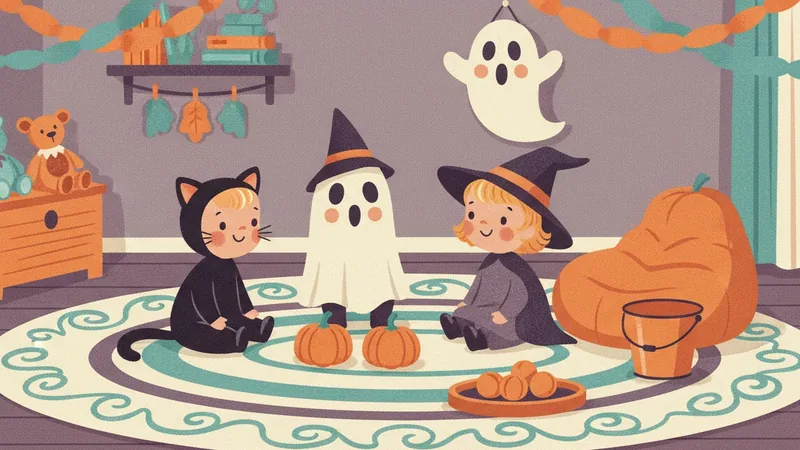
Planning games for your group of three-year-olds means picking things they can do without reading and without a scare. The best preschool Halloween games last about 10 minutes, use pictures for the rules, and have one clear thing to do.
Preschoolers cannot read the rules, will not sit still for long, and can be frightened by a mask. So the eight games below use a picture or a demonstration for every rule, run about 10 minutes each, and keep the mood friendly. Each entry names the skill it builds, the setup and what to say.
1. Pumpkin bean-bag toss for ages 3 and up
Set a large box or a pumpkin-colored bucket on the floor and give each child a bean bag. Children stand on a tape line and toss. You show the rule with one picture on the wall: a child standing on a line with an arrow to the pumpkin.
Throwing uses the whole arm and the legs, so the bean-bag toss counts as a gross motor game. You need 10 minutes. Put the line about 3 feet from the bucket for 3-year-olds and 5 feet for 5-year-olds, which is our own estimate. Clear your space first. The Consumer Product Safety Commission advises removing obstacles from lawns, steps and porches, and the same rule works for your classroom floor.
2. Ghost freeze dance for ages 3 and up
Play music, and let the children dance like ghosts with floaty arms. When the music stops, they freeze. Hold up a picture of a ghost standing still so the children know what freezing looks like.
Freeze dance is a gross motor game with a built-in listening task. Run 5 to 8 minutes, because it tires a room quickly. You prepare nothing except a speaker and one picture. Slow bat wings make a calmer round, with arms moving in big circles.
3. Mini-pumpkin roll for ages 3 to 5
Give each child a mini pumpkin and let them roll it along the floor to a line of tape. Use pumpkins small enough to hold in two hands. Children push the pumpkin, run after it and roll it back.
Rolling builds gross motor skills and teamwork, and the pumpkin is the only prop. Allow 10 minutes. A picture of a pumpkin with an arrow pointing at the tape line is all the rule you need. Wipe the pumpkins afterward, and use a real pumpkin only if your floor can take a little dirt.
4. Pom-pom pumpkin patch for ages 3 and up
Cut a paper pumpkin shape, tape it to a cup or a small bowl, and fill a tray with orange pom-poms. Children pick up pom-poms with fingers, a spoon or large tongs and drop them into the pumpkin. The picture rule shows a hand, a pom-pom and an arrow to the pumpkin.
Pinching and dropping is fine motor practice. The Centers for Disease Control and Prevention lists "Strings items together, like large beads or macaroni" among its milestones for age 3, so pinching and placing small things is a typical skill at this age. Offer fingers first and tongs second, and give it about 10 minutes. Use pom-poms bigger than a child's mouth can swallow, and stay at the table with the youngest children, so you can step in.
5. Pumpkin touch-and-guess bag for ages 3 and up
Put a mini pumpkin, a plastic spider ring that is too big to swallow, a soft felt bat and a paper cup into a cloth bag. Each child reaches in, feels one thing and says what it is. The picture rule shows a hand going into a bag.
Feeling inside a bag is a sensory game for the hands, and a good quiet one between active games. Six children need about 10 minutes. You choose objects that are soft, smooth or bumpy, and leave out anything scary or wet. Some children will not reach into a bag, and that is fine. Let them peek, or pull one object out with you.
A bigger sensory activity is a bin: fill a bin with dry oats or rice and hide a few small plastic pumpkins in it. You stay beside the bin.
A preschool game is finished when the children want to do it again, not when the clock runs out.
6. Halloween Picture Bingo for ages 3 and up
Picture bingo works for children who cannot read because the cards show pictures, not words. In Halloween Picture Bingo, there are 10 different bingo cards, one per child, and 24 picture calling cards you cut apart. You hold up a picture, and each child looks for it on the card. Every picture is also labelled, so a classroom helper who can read can check. The game comes with 36 candy-corn markers, and you can use raisins or crayons instead.
Printing and cutting takes about five minutes, and play takes about 10. Bingo builds matching and looking skills at the tables, so it gives a room a calm turn. It is the one game here that you buy as a file. It sits in the Kids' Party Bundle, along with a memory game and a scavenger hunt.
7. Matching pairs memory game for ages 3 and up
Lay out 8 pairs of picture cards face down. Children flip two cards at a time and look for a match. Start with 8 pairs, and for younger children use only 4.
Memory trains attention and hand control, because flipping cards is a small, careful move. A homemade set can be as simple as 8 stickers on index cards, cut in pairs. Halloween Memory Game has 24 picture pairs, with 8 of the easiest pairs marked with a star for little ones, and three ways to play: Easy with 8 pairs, the Full game and Snap. A round lasts about 10 minutes at a small table.
8. Pumpkin-patch picture hunt for ages 4 and up
Tape 8 pictures of pumpkins, ghosts and bats at a child's eye level around the room. Each child gets a picture checklist, and ticks off what they find. The rule is one picture of a child pointing at a ghost on the wall.
Children spend about 10 minutes walking, spotting and ticking, so the hunt is a gross motor and looking game at once. Halloween Scavenger Hunt is made for this, with 16 illustrated find-it cards and a checklist with tick boxes, one per child, for ages 3 to 9. A first hunt with 3-year-olds needs only 4 or 5 pictures and hide them at eye height.
Small rooms and tears: indoor games and fair play
In your small classroom or living room, choose the sitting and spot-bound games. Picture bingo, memory pairs, the touch-and-guess bag and the pom-pom patch need only a table or a rug. Freeze dance works in a space as small as a rug, because children dance in place. Do the bean-bag toss and the pumpkin roll in a hall or outdoors. You can also shorten the distance and push your furniture back.
To keep tears down, make every game one where all children finish with something. Play freeze dance without anyone being out. Give each child a turn at the toss, and count every bag as a point for the group. Let bingo run until every child has a full card. You can say "we are all ghosts together" instead of naming a winner. If a child is upset, ask them to hold the bean bags or call the pictures, which keeps them in the game.
How to choose preschool Halloween games by skill and age
Choose by the youngest child you have, then by the energy in your room. If your group has been sitting, it needs a movement game. If it just ran, it needs a calm one. Alternate the two. The CDC says children aged 3 to 5 should be physically active throughout the day, so a movement game is not extra. It is part of your day.
The table below puts the eight games side by side. The minutes and age ranges are our own estimates for a group of about six children.
| Game | Age | Minutes | Skill | Setup |
|---|---|---|---|---|
| 1. Pumpkin bean-bag toss | 3 and up | 10 | Gross motor | Box, bean bags, tape line |
| 2. Ghost freeze dance | 3 and up | 5 to 8 | Gross motor, listening | Music, one picture |
| 3. Mini-pumpkin roll | 3 to 5 | 10 | Gross motor | Mini pumpkins, tape |
| 4. Pom-pom pumpkin patch | 3 and up | 10 | Fine motor | Tray, pom-poms, cup |
| 5. Touch-and-guess bag | 3 and up | 10 | Sensory | Cloth bag, 4 objects |
| 6. Picture bingo | 3 and up | 10 | Matching | Print and cut, 5 minutes |
| 7. Memory pairs | 3 and up | 10 | Attention, fine motor | 8 pairs of cards |
| 8. Picture hunt | 4 and up | 10 | Gross motor, looking | Tape 8 pictures up |
| Skill | Games |
|---|---|
| Gross motor | 1, 2, 3, 8 |
| Fine motor | 4, 7 |
| Sensory | 5 |
| Matching and attention | 6, 7 |
Games that use cards and pictures are the ones to buy, because cutting and printing them is the slow part. The Kids' Party Bundle holds the picture bingo, the memory game and the scavenger hunt in one download. Free printables exist, and for one game they are often enough. What the paid files add is a matching set in one design, both US Letter and A4 sizes, and nothing to redraw. They are PDFs that open in any PDF reader, so you need no other app, and the games here are printed and played by hand. The PDF comes by email after checkout, so you can print it the same day. The bundle is the wrong choice if you have no printer or if you want only movement games, which need nothing but a box, a bean bag and a speaker.
Two last things. Keep every game friendly: no masks on adults, no sudden loud sounds, no dark room. And keep a spare, calm game ready for the child who wants to stop, so you are never stuck. A touch-and-guess bag or a few memory cards at the side of the room does the job.
FAQ
What are some fun Halloween games to play with preschoolers?
Pumpkin bean-bag toss, ghost freeze dance, picture bingo and a memory match all work for ages 3 to 5. Each runs about 10 minutes, has one rule you can show with a picture, and has nothing scary in it.
What are some fun Halloween activities for 3-year-olds?
Matching pictures, a pumpkin roll, a freeze dance and a touch-and-feel pumpkin bin suit 3-year-olds. Keep each one to one step and about 10 minutes, and show the rule with a picture or a demonstration.
What are some fun sensory activities for Halloween?
A pumpkin bin with scooped seeds, a mystery bag with a pumpkin and a ghost to feel, and play dough with orange and black are easy sensory ideas. Stay beside the bin, and keep small items out of reach of children who still put things in their mouths.
What are some Halloween-themed fine motor activities?
Moving orange pom-poms into a paper pumpkin with tongs or fingers, stringing large beads or macaroni, and coloring a pumpkin page all use small hand muscles. The CDC lists stringing large beads or macaroni among its milestones for age 3.
What are some Halloween-themed gross motor activities?
Pumpkin bean-bag toss, a mini-pumpkin roll, a bat-wing freeze dance and a ghost walk along a line of tape get children running, jumping and balancing. The CDC says children aged 3 to 5 should be physically active throughout the day.
What are some fun Halloween games for a classroom?
Start with picture bingo and a memory match at the tables, and add a freeze dance or a bean-bag toss for a movement break. Short games of about 10 minutes keep a room of preschoolers together.
Conclusion
Match the game to the child, not the holiday. A 3-year-old needs a game with one picture and one move. A 5-year-old can follow two. You can run about three games of 10 minutes each, put a calm one between the active ones, and keep every game friendly. If a child backs away from a mask or a loud noise, drop it and move on.
Sources
- Centers for Disease Control and Prevention, Milestones by 3 Years (2025). Last checked October 7, 2026.
- Centers for Disease Control and Prevention, Child Activity: An Overview (2025). Last checked October 7, 2026.
- Consumer Product Safety Commission, CPSC Offers Safety Tips to Keep Hazards from Haunting Your Halloween (2022). Last checked October 7, 2026.