Clues for a Halloween Treasure Hunt: How to Write Them
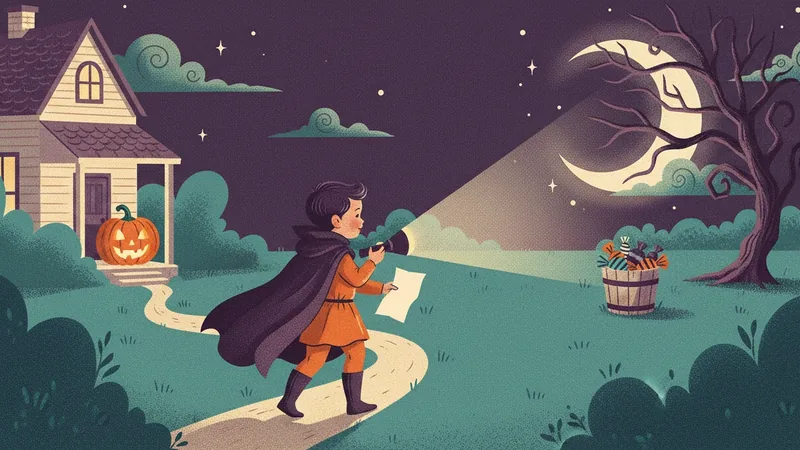
You have the candy, the kids and an hour, and now you need the clues. Good clues for a Halloween treasure hunt are short notes that each point to the next hiding spot. Write them as pictures, rhymes or riddles to match the age of the child holding them.
A hunt falls apart in one of three places. The clues are too hard for the youngest child. Two clues point to the same spot. Or a clue goes missing and the group stands still. The five steps below fix each one. They cover how to choose the spots and how to write clues for each age. You will also chain them, pick the prize and run the hunt. The same steps work for a treasure hunt, a scavenger hunt and a clue game.
| Step | What you do | Time |
|---|---|---|
| Step 1 | Pick 8 to 12 hiding spots and write the route | 15 minutes |
| Step 2 | Write one clue per spot, in the style for your age group | 30 minutes |
| Step 3 | Chain the clues, number them and test the route | 15 minutes |
| Step 4 | Choose the prize at the end, with an allergy check | 10 minutes |
| Step 5 | Run the hunt with a hint rule and a safe space | 20 to 40 minutes |
The times are our own estimates for a house hunt with about 10 spots, and they will change with your space.
Step 1: Pick the hiding spots and the route
Walk through the rooms you will use and write down 8 to 12 spots a child can reach without a stool. Choose objects with a clear name: the fridge, the mailbox, the porch pumpkin, the shoe basket, the bathtub, the dog bed. Avoid spots that look alike, such as two bookshelves, because a clue for one will also send children to the other.
Put the spots in a loop, so that the last one is close to the finish. Keep the first spot easy and the last spot the most fun. A yard or a porch suits a dark or outdoor hunt. Mark the boundary clearly. A treasure hunt for the whole party can also be a neighborhood walk, but only when every child has a grown-up with them.
At a party the spots can be pictures instead of places. A list of finds such as a pumpkin, a bat, a ghost, a black cat, a spider web and something orange makes a quick scavenger hunt list. Ten to 16 items is plenty for ages 3 to 9.
Step 2: Write clues for a Halloween treasure hunt by age
Write each clue for the youngest reader in the group. A clue is a message from one spot to the next. It has one job. It must send the child to the right place. Here is the style that works at each age.
- Ages 3 to 5, pictures. Children who cannot read follow a drawing. Draw the next spot in black marker on an index card: a fridge, a shoe, a front door. One picture, no words.
- Ages 6 to 8, rhymes. Early readers like a rhyme because it tells them what the last word will be. Two lines are enough.
- Ages 9 to 11, riddles. Describe what the object does, in two or three lines, without saying its name.
- Ages 12 and up, riddle chains and photo tasks. Make them solve a riddle, then take a photo at the spot to prove it. Hide one clue in a surprising place.
The table gives one example for each age, so you can copy the pattern with your own spots.
| Hiding spot | Picture clue (ages 3 to 5) | Rhyme clue (ages 6 to 8) | Riddle clue (ages 9 to 11) |
|---|---|---|---|
| Fridge | Draw a fridge | "Cold milk and ghostly cheese, look inside and say 'Boo, please!'" | "I hum all night and keep things cold. Open my door and be bold." |
| Porch pumpkin | Draw a pumpkin with a smile | "Orange and round with a toothy grin, look where the candle lives within." | "I have a face but no head. I glow at night. Find me by the door." |
| Shoe basket | Draw a shoe | "Left and right, two by two, a witch lost one, so look for you." | "We come in pairs and wait by the door. We carry feet, but we are not alive." |
| Bathtub | Draw a bathtub | "Splash, a ghost took a bath, hide a clue along his path." | "I fill with water, I drain away, I hold a ghost on Halloween day." |
Read each clue out loud once before the party. If you stumble, a child will stumble too. Rewrite it.
Step 3: Chain the clues so the hunt does not stall
A chain is a line of clues where each one is hidden at the spot the clue before it named. Number them. Clue 1 goes in the children's hand. Clue 2 is at spot 1, clue 3 is at spot 2, and the prize is at the last spot. A chain only works when every clue points at exactly one place.
Most hunts stall for one of three reasons. A clue points to two places, a clue is missing, or a child finds the clue early. Number each card on the back so you can tell at a glance which one is missing. Keep a short list of the route in your pocket, with the spot for each number. A host hiding log does the same job, and it also makes sure every clue comes back after the party.
Walk the route once before the party, clue in hand, and hide the real clues as you go. This is the only test that finds a missing card. With two teams, use two colors of card and two routes, so the teams do not follow each other.
Step 4: Choose the prize at the end
The last spot holds the treasure. A bucket of wrapped candy is the classic choice. In a 2021 survey, the National Confectioners Association found that 60 percent of Americans prefer chocolate to non-chocolate candy, with chocolate ranked first overall. Wrapped chocolate is an easy prize to hide and carry.
Check the wrappers for allergies. Food Allergy Research & Education says that the mini-size, fun-size or bite-size version of candy may contain different ingredients than the full-size one, and that you should read the label every time. Put a non-food prize in the bucket as well, such as stickers, glow sticks or a certificate. Then a child who cannot eat the candy still wins something.
Give every child a prize. A hunt that ends with one winner makes the youngest child cry. A prize per child, plus a bonus for the first team home, keeps everyone happy.
Step 5: Run the hunt with a hint rule
Hand out clue 1, say "go," and stay near the route. Set one rule before the start. A child may ask for one hint card per clue. The hint names the room only. Write the hint on the back of each clue, or keep a stack of cards in your pocket.
After dark, send the children out in pairs and give each pair a flashlight. The Consumer Product Safety Commission says that a brightly colored costume and a flashlight or glow stick can help brighten the walkways. Say out loud where they may not go.
A good hunt is a story with a map hidden in it.
When a child finds the treasure, call them back to the start and let them tell the next group where they looked. That keeps the finished children busy while the others finish.
If you would rather skip the writing, Halloween Scavenger Hunt has 16 illustrated find-it cards, 16 optional rhyming clue cards and a host hiding log. It is made for ages 3 to 9. It is the wrong choice when the children are 10 or older. Its cards are made for younger children, so for tweens, write the riddles yourself with Step 2. Free printable hunts exist and can be good enough for one party. The paid file gives you a matching set in one design, both paper sizes, and nothing to redraw. It is a PDF that opens in any PDF reader, so you do not need any other app. The PDF comes by email after checkout, so you can print it the same day. Print at home at actual size, as often as you need for your own party.
FAQ
How to make up clues for a treasure hunt?
Pick the hiding spots first, then write one clue per spot that describes the next spot. Hide each clue at the spot the previous clue names. Write picture clues for children who cannot read, rhymes for early readers and riddles for ages 9 and up, and test the route once before the party.
What are some easy clues for a treasure hunt?
Easy clues name a thing the child sees every day: "Look where we keep the cold milk" for the fridge, or a drawing of a shoe for the shoe basket. Use one-line clues and a picture for children under 6.
What are some clever clues for a treasure hunt?
Clever clues point at a spot without naming it, such as a riddle about a jack-o'-lantern on the porch, or a clue written backwards for a mirror. Keep them for children who read well, ages 9 and up, and always include a hint card.
What are some good riddle clues for a scavenger hunt?
Describe the object by what it does. "I have a face but no head, I glow at night, and I sit on the porch" points to a jack-o'-lantern. Write two or three short lines, make each riddle have one answer, and test it on someone who is not helping you.
What are some ideas for a Halloween scavenger hunt?
Run a house hunt with clues, a candy hunt with wrapped candy, a photo hunt on phones, a neighborhood walk to look for decorations, or a party hunt with find-it cards. Pick the one that matches your space and the age of the children.
How to make a scavenger hunt more interesting?
Add a story, such as a ghost who lost his treasure, split the children into teams, add a timer, and finish with a prize. For older children, mix riddles and photo tasks, and hide one clue in a surprising spot.
What is the #1 favorite Halloween treat?
In a 2021 National Confectioners Association survey, chocolate came first. Sixty percent of Americans preferred chocolate to non-chocolate candy, and gummies came second. For a hunt, wrapped chocolate is the easy prize to hide.
Is there a prize at the end of a scavenger hunt?
Most hunts end with a prize, and it does not need to be big. A bucket of wrapped candy, a small toy or a certificate for every child works. Give a prize to every child so the youngest players do not go home empty-handed.
What are good prizes for a Halloween party?
Wrapped candy, glow sticks, stickers, small toys and a certificate all work. Because fun-size candy can contain different ingredients from the full-size bar, add a non-food prize for children with food allergies.
What are some good items to put in a scavenger hunt?
For Halloween, use things children can find or photograph: a pumpkin, a bat, a ghost, a black cat, a spider web, a candy wrapper, something orange and something purple. Use 10 to 16 items for ages 3 to 9.
Conclusion
A hunt that works has three parts. You pick the spots on purpose. You write the clues for the age of the reader. And you hide every clue at the place the last one named. Walk the route once before the party, number every clue, and keep a few hint cards in your pocket. Then the children run, and you watch.
Sources
- Consumer Product Safety Commission, CPSC Offers Safety Tips to Keep Hazards from Haunting Your Halloween (2022). Last checked October 7, 2026.
- Food Allergy Research & Education, Allergy-Safe Tips for Trick-or-Treating (undated). Last checked October 7, 2026.
- National Confectioners Association, NCA Survey Says Most Consumers Want Chocolate Halloween Candy (2021). Last checked October 7, 2026.