Halloween Party Games for Tweens: What Keeps Them In
What do you run for 10- to 13-year-olds who call every kids' game babyish and are not allowed the adult ones? Halloween party games for tweens work when they come with teams, a clock and a score everyone can see, and when each game fixes something that would otherwise empty the room. The seven games below sit inside those fixes, with minutes, supplies and scoring for a group of about eight.
Eye-rolls: Halloween party games for tweens need a score on the wall
The fix for the eye-roll is a contest. Draw two or three teams of 4 to 6 from a bowl of names. Tape one sheet to the wall with the team names across the top and the games down the side, and give every game a point value before it starts. A 12-year-old who would never pass a pumpkin for its own sake will pass it for a point the whole room can see.
Teams matter more at this age than they did at 7. Guidance from the Centers for Disease Control and Prevention says that children aged 9 to 11 form stronger friendships and that having friends becomes more emotionally important to them. The same page says peer pressure can become strong, so every dare in this article is optional, and a player who passes loses nothing.
Before the doorbell, have four things ready.
- The team draw, as folded names in a bowl, so nobody picks their friends.
- The scoreboard sheet, with every game written in, so the night has a visible end.
- A phone with a 60-second timer that the whole room can hear.
- An empty basket by the door for the guests' phones.
Say each rule once, in one sentence, and let the judge settle arguments.
The first ten minutes are dead while guests trickle in
Start with a game that latecomers can join mid-round, and Would You Rather with sides is the one. Read a question, and every player walks to the left wall or the right wall. Then pick one player on each side to defend the choice in 20 seconds, and the judge gives a point to the better argument.
Write 10 to 12 questions on index cards the night before. Keep them funny, such as a pet bat or a pet spider, and leave out anything scary. In a small room, hands on head or hands on hips replaces the walk. Plan on about 10 minutes, and stop while they still want one more question, because the leftover cards come back later as tie-breakers.
The room is loud and nobody listens to rules
When the volume climbs, run games that end in 60 seconds and need one sentence of rules. Three of them fill about 30 minutes with rematches, and all three use things from the kitchen. Run each as a relay, so a team of six gets six turns.
- Pumpkin pass. A mini pumpkin the size of a softball goes down the line under the chin, with no hands. A dropped pumpkin goes back to the first player. Score the number of players it reached when the timer rings, and push the furniture back first.
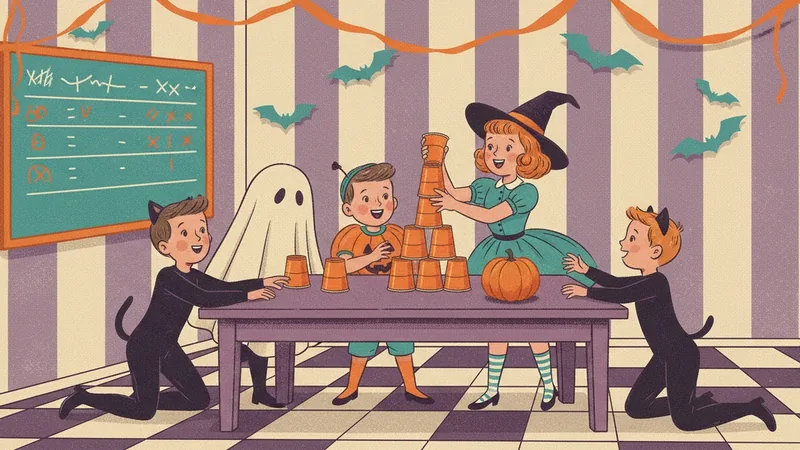
- Ghost cup tower. Each player gets 10 plastic cups, stacks them into a pyramid and takes the pyramid back down into one stack. A tower that falls is rebuilt. The fastest clean stack wins the heat.
- Eyeball spoon race. A bowl of 15 ping-pong balls, an empty bowl and a spoon, with one hand behind the back. Score the balls moved in 60 seconds. Keep the bowls on a table, because dropped balls roll everywhere.
When they ask for one more loud round, the mummy wrap race takes two rolls per team and about ten minutes.
The quiz turns into an argument, or a 13-year-old finds it easy
A quiz holds this age group when the scoring is public and the host holds the answers. Read 20 questions, give each team 15 seconds, and let the other team steal when the first one misses. One point per question, and a hard tie-breaker at the end that you wrote yourself. An answer sheet in your hand ends most arguments before they start.
If you would rather write your own, start from these 15 Halloween trivia questions with sourced answers and add ten of your own. Printed question cards do the same job when they come with a host answer sheet and a score sheet, and the deck that fits this age is in the printing section near the end.
The quiet kids have nothing to win
Give the quiet kids one seated round they can take, and the word-search race is it. Hand each team the same puzzle face down. On "go" they flip it, and the first team to circle every word wins the round. Ask each team to use a different pen color, so you can check the sheets in a minute. The round takes about 5 to 10 minutes.
The grid has to be hard, or the race is over in 90 seconds. Look for a 15 × 15 grid with about 15 words running in all 8 directions, backwards and diagonal included, and an answer key that places every word so checking takes a minute. An easy grid made for younger children ends the race before the shy player finds a word. A free online word-search generator with the team's own 15 words does the job, and the printed option is in the section near the end.
Phones come out between games
The phones go into the basket by the door, and they come out once, for the photo scavenger hunt. Hand each team a list of 12 photo targets, one phone and 20 minutes. Set the boundary out loud, such as the house and the yard. The judges give 1 point per photo and a bonus for the funniest.
Silly targets work better than hard ones: a team pyramid, a mummy wrapped in toilet paper, something orange, a dramatic ghost leap. If the hunt runs into the yard after sunset, the Consumer Product Safety Commission says that wearing a brightly colored costume and carrying a flashlight or glow stick can help brighten the walkways. Hand out glow sticks before the yard part, or keep all 12 targets indoors.
A round stalls halfway
Call the swap in 30 seconds, without a lecture, and have it ready before the party. Match it to the room.
- Restless and loud. Run one of the 60-second games, because the clock ends it before anyone gets bored.
- Quiet and shy. Run the word-search race, seated, with a clear way in for every player.
- Split into cliques. Redraw the teams from the bowl and send the new teams on the photo hunt, because mixed teams have to talk.
- One kid says it is lame. Hand that kid the timer and run Halloween charades with the hardest prompts.
- Dark outside. Cut the photo hunt to 8 indoor targets.
A stalled round is often a rule problem, so repeat the one sentence and restart the clock before you swap at all.
You bought a printable and half of it is for 6-year-olds
Print for the age in the room. The Party Games Bundle is $13.99 for eight printable games, and three of them fit a tween night. Bought singly, Halloween Trivia for Kids ($3.00), Halloween Word Search ($3.00) and the Halloween Puzzle Pack ($4.00) come to $10.00, so the bundle makes sense when younger siblings are coming too. The puzzle pack holds nine puzzles in two levels for ages 6 to 12, with answer keys, for a quiet table.
The trivia deck has 20 "Big Bats" cards for ages 8 to 12, the answer printed small and upside down on each card, a score sheet for up to 6 teams and host answer sheets, and a 13-year-old sits at the top of its range. The word search has two hard 15 × 15 puzzles, 15 words in all 8 directions with at least four backwards and four diagonal in each, and a key that gives the row, column and direction of every word, so print only those two pages.
The other five are made for younger children. Halloween Picture Bingo is for ages 3 and up, the Halloween Scavenger Hunt for ages 3 to 9, and the Halloween Memory Game plays from age 3 with its starred pairs. Pass the Candy Circle and Finish the Phrase are written for ages 4 and up.
The games in the first three fixes and the photo hunt need no printing at all. Free printables cover one game well. The paid files add a matching set in US Letter and A4 with answer keys, as a PDF by email after checkout.
Cliques, and the kid who says this is lame
Draw the teams from the bowl, and redraw once at the halfway point, so a clique never gets a whole night together. The kid who acts too cool usually wants a job, so make the loudest critic the judge, the timer or the scorekeeper.
Prizes go to a team, and all 4 to 6 members of the winning team get the same small thing, such as glow sticks, stickers or a bag of wrapped candy. Add a loudest-team award for the whole group, so the losing side goes home with something too. The last prize is for the best argument of the night, from the Would You Rather round, and it goes to one player. The judge reads that name out loud.
Sources
- Centers for Disease Control and Prevention, Positive Parenting Tips: Middle Childhood (9-11 years of age) (undated). Last checked October 7, 2026.
- Consumer Product Safety Commission, CPSC Offers Safety Tips to Keep Hazards from Haunting Your Halloween (2022). Last checked October 7, 2026.
How we write and check these guides: our editorial note.