Trivia Questions About Halloween With Answers: 15 Sourced Ones
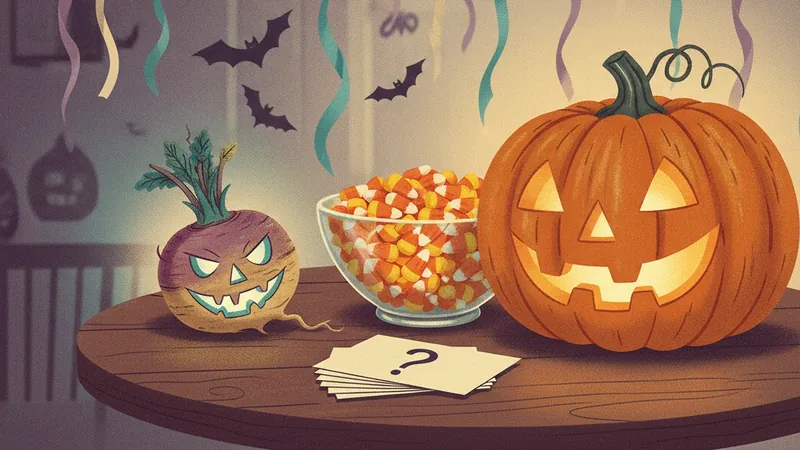
You have ten minutes before the guests sit down and nothing to ask them. These trivia questions about Halloween with answers give you 15 history questions in three rounds. Every answer comes from a page you can open yourself.
Good trivia depends on answers you can defend. Every question below has one clear answer. A dated page backs each one, from the Library of Congress, a museum, a university or a trade association. Where scholars disagree, the question says so, and where a source did not back a fun fact, the fact is left out.
Trivia questions about Halloween with answers, in three rounds
Each round has five questions. Read the question aloud, give players a few seconds, then read the answer, which follows each question, and the source. Round 1 suits ages 5 and up. Round 2 suits ages 8 and up. Round 3 is for halloween trivia questions for tweens and grown-ups.
Round 1: easy, ages 5 and up
1. What was Halloween called in its old name, All Hallows' ____? Eve. The Library of Congress says the evening before All Saints Day was known as All Hallows Eve, and later Halloween.
2. What were the first jack-o'-lanterns carved from in Ireland? Turnips. The same Library of Congress page says the tradition of carving jack-o'-lanterns began in Ireland with turnips, not pumpkins.
3. Name one other vegetable people carved faces into besides turnips. Potatoes, radishes or beets. Smithsonian Magazine says people in the British Isles carved faces into turnips, and in some cases potatoes, radishes and beets.
4. What bigger, easier-to-carve crop did Irish immigrants find in North America? The pumpkin, a winter squash. The Carnegie Museum of Natural History says immigrants found a crop much larger and easier to carve than their root vegetables at home.
5. In which decade, according to legend, was candy corn invented? The 1880s. The National Confectioners Association says that according to legend, a Wunderlee Candy Company employee named George Renninger invented it then. Note the word "legend": say it when you read the answer.
Round 2: medium, ages 8 and up
6. Which ancient Celtic festival is the best-known ancestor of Halloween? Samhain, said "SAH-win." The Library of Congress calls it an ancient, pre-Christian Celtic festival, with bonfires and costumes to ward off ghosts.
7. Which pope, in the eighth century, designated November 1 as a time to honor saints? Pope Gregory III, per the Library of Congress. All Saints Day then took on some of the traditions of Samhain.
8. What are November 1 and November 2 called? All Saints' Day (also All Hallows' Day) and All Souls' Day. The Library of Congress research guide places All Saints or All Hallows on November 1 and All Souls Day on November 2.
9. What is the three-day Catholic celebration called that includes Halloween? Allhallowtide. Northeastern University says it spans All Hallows' Eve on October 31, All Hallows' Day on November 1 and All Souls' Day on November 2.
10. What is the name of the trickster in the Irish folktale behind the jack-o'-lantern? Stingy Jack, who the Smithsonian says tricked the devil and was left to roam the earth for eternity.
Round 3: hard, tweens and grown-ups
11. In which century did Halloween reach America with Irish immigrants? The 19th century. A UCLA history of Halloween says there was no Halloween celebration, or even an idea of it, in America until the 19th century, when it came with the Irish immigrants.
12. Which 1840s disaster in Ireland sent waves of immigrants, and their jack-o'-lantern habit, to America? The Great Potato Famine. The Carnegie Museum of Natural History names the waves of immigrants it created.
13. What changed trick-or-treating into a standard night for children in new suburbs? The postwar baby boom. The Heinz History Center says Halloween became an event for children, with "Trick or Treating" perfect for new suburban neighborhoods.
14. In what year, and in which city, did kids first collect coins in milk cartons for UNICEF on Halloween? 1950, in Philadelphia, and they collected $17. National Geographic Education tells the story.
15. True or false: scholars all agree that Halloween comes straight from Samhain. False, so be careful with the word "straight." A folklorist at Ohio State, quoted by Ohio State University, says some believe Halloween came from ancient pagan culture, "or perhaps it originated with Samhain." The Library of Congress tells the Samhain and All Saints story as a blend of Christian and pre-Christian belief.
Answer sheet for halloween history trivia questions and answers
Print this table for the quizmaster, or copy it onto a card. Points are our own suggestion: 1, 2 and 3 for the three rounds.
| # | Round | Answer | Where it comes from |
|---|---|---|---|
| 1 | Easy | Eve | Library of Congress |
| 2 | Easy | Turnips | Library of Congress |
| 3 | Easy | Potatoes, radishes or beets | Smithsonian Magazine |
| 4 | Easy | The pumpkin | Carnegie Museum of Natural History |
| 5 | Easy | The 1880s (legend) | National Confectioners Association |
| 6 | Medium | Samhain | Library of Congress |
| 7 | Medium | Pope Gregory III | Library of Congress |
| 8 | Medium | All Saints' and All Souls' Day | Library of Congress guide |
| 9 | Medium | Allhallowtide | Northeastern University |
| 10 | Medium | Stingy Jack | Smithsonian Magazine |
| 11 | Hard | The 19th century | UCLA |
| 12 | Hard | The Great Potato Famine | Carnegie Museum of Natural History |
| 13 | Hard | The postwar baby boom | Heinz History Center |
| 14 | Hard | 1950, Philadelphia, $17 | National Geographic Education |
| 15 | Hard | False | Ohio State University |
How to score a round for mixed ages
Give 1 point for each Round 1 answer, 2 for each Round 2 answer and 3 for each Round 3 answer. That makes the most a team can win 5 + 10 + 15 = 30 points. Younger players can still score on every Round 1 question and steal a Round 2 answer, so no team sits out.
The table shows the three rounds side by side. Score by round, and give every team the same questions.
| Round | Questions | Best for | Points each |
|---|---|---|---|
| 1 Easy | 1 to 5 | Ages 5 and up | 1 |
| 2 Medium | 6 to 10 | Ages 8 and up | 2 |
| 3 Hard | 11 to 15 | Tweens and adults | 3 |
Mixed teams work better than age groups. Put one older child or adult on each team of three or four. Let the youngest player give the final answer on Round 1 questions. A wrong answer passes to the next team, which can steal the point. If two teams tie, ask a sudden-death question from the answer sheet and award the point to the first correct team.
A trivia question is only fair if the person reading the answer can say where it came from.
For a quick round of about 10 minutes, ask 10 questions: Rounds 1 and 2, or any 10 you pick. That pacing is our own estimate at roughly a minute per question with the answer and source read aloud. Add Round 3 when you have 15 to 20 minutes.
Mark question 5 and question 15 with a star on the quizmaster sheet. Those are the two where the honest answer has a hedge ("legend" and "perhaps"), and reading the hedge aloud keeps the game accurate.
Ready-made cards when you do not want to write your own
If you would rather skip the writing and cutting, Halloween Trivia for Kids is a $3 PDF with 40 question cards. You get 20 Little Pumpkins cards for ages 5 to 7 and 20 Big Bats cards for ages 8 to 12. The answer is printed small and upside down on every card, so the reader never needs a separate sheet. It also has a score sheet for up to 6 teams and host answer sheets for both levels.
The cards are the wrong choice if you want history questions with a named source for each answer. Its cards are written for ages 5 to 12 and lean on animals, bones, pumpkins and the moon, with only one hedged history question. For the history rounds above, use this article's list. It is also not made for adults or tweens who want a hard quiz.
The pack is a PDF that opens in any PDF reader, so you need no other app. It has no type-in fields: you print it and write team names and scores by hand. It comes by email after checkout, so you can print it the same day, and it holds US Letter and A4 pages. Free printables exist and can be enough for one quick round. What the paid file adds is a matching set of 40 cards in one design, both paper sizes and nothing to redraw.
For a fully free route, copy the questions above onto index cards. Fold each card in half with the question on the front and the answer and source inside. You have a printable set in about ten minutes.
Three mistakes that spoil a Halloween quiz
Asking a question whose answer is a matter of taste is the first. "Which candy is best?" starts an argument and never ends. Stick to questions with one answer a page can confirm.
The second mistake is a question that is too hard for the youngest player in the room. If one child sits silent through five questions in a row, move to a question they can answer or let their team confer.
The third is a fun fact with no source. Many Halloween "facts" travel by repetition, and some of them fall apart when you check. If you cannot say where an answer comes from, drop the question before the game.
FAQ
What are some easy Halloween trivia questions?
Try "What was Halloween called in its old name?" (All Hallows' Eve), "What were the first jack-o'-lanterns carved from?" (turnips) and "What vegetable replaced it in North America?" (the pumpkin). All three are in Round 1 above, with the page that backs each answer.
What are some interesting facts about the history of Halloween?
The Library of Congress says Halloween began as the ancient Celtic festival of Samhain, and that in the eighth century Pope Gregory III designated November 1 as a time to honor saints. The evening before became All Hallows' Eve, and later Halloween. Irish immigrants then carried the holiday to America.
What are some historical trivia facts about Halloween?
Jack-o'-lanterns started in Ireland and Britain as carved turnips, not pumpkins. Trick-or-Treat for UNICEF began in 1950 in Philadelphia, when school kids collected $17 in milk cartons. Candy corn is credited by legend to a candy-company worker in the 1880s.
What are some common Halloween-related words?
Samhain (the Celtic festival, said "SAH-win"), All Hallows' Eve, All Saints' Day, All Souls' Day, Allhallowtide and jack-o'-lantern. Each has a trivia question in this article, and the Library of Congress and Northeastern University pages explain how they fit together.
What are common trivia night questions?
Good trivia night questions have one clear answer, a source you can name and a difficulty you can label. Group them in rounds of five, from easy to hard, and give more points for the harder rounds so mixed ages can still compete.
What are some spooky facts?
Stingy Jack is the trickster of the Irish tale behind the jack-o'-lantern. He was condemned to roam the earth with only an ember, which is why people carved faces into turnips to keep spirits away.
Conclusion
Start with the easy round so every child scores. Move to the medium round for the middle ages, and keep the hard round for tweens and adults. Read the answer, say where it comes from, and let anyone challenge it. A quiz you can back up with a library or museum page runs smoother than one you have to defend from memory.
Sources
- Library of Congress, The Origins of Halloween Traditions (2021). Last checked October 7, 2026.
- Library of Congress, Halloween & Día de Muertos Resources, Introduction (undated). Last checked October 7, 2026.
- Smithsonian Magazine, When People Carved Turnips Instead of Pumpkins for Halloween (2021). Last checked October 7, 2026.
- Carnegie Museum of Natural History, The Jack-O-Lantern's Origins (undated). Last checked October 7, 2026.
- UCLA Newsroom, The Great Pumpkin: A UCLA History of Halloween (2012). Last checked October 7, 2026.
- National Confectioners Association, Everything Candy Corn (undated). Last checked October 7, 2026.
- National Geographic Education, Trick-or-Treat for UNICEF (2009). Last checked October 7, 2026.
- Northeastern University, No tricks, just treats: The real story of Halloween (2018). Last checked October 7, 2026.
- Ohio State University, The beating heart of Halloween? Folklore (2024). Last checked October 7, 2026.
- Heinz History Center, Whoooo Will You Be on Halloween? The Changing Face of America's Spookiest Holiday (2016). Last checked October 7, 2026.