Halloween Charades Game: Rules, Teams and Prompts
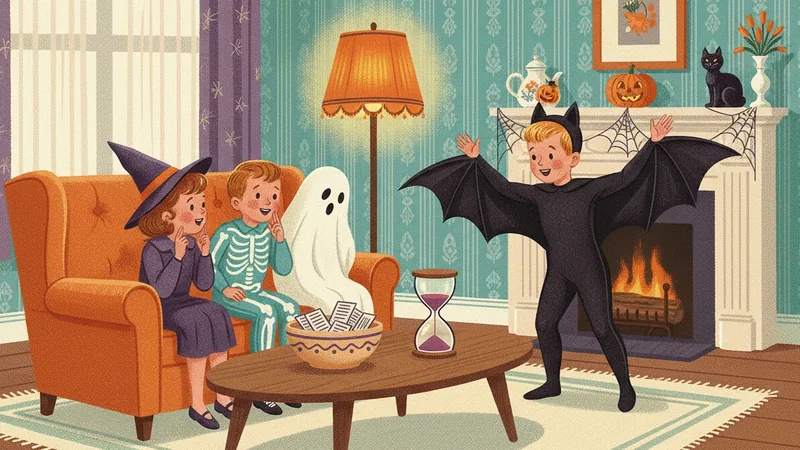
A mixed group and no props can make guessing games feel risky. A Halloween charades game needs only two teams, a timer and a bowl of prompts, and you can start it in about five minutes.
Charades is the Halloween game that needs the least from you. You write prompts on slips of paper, split the players into two teams and set a timer. Players act each prompt in silence and their team guesses. This guide gives you the rules, the turn order and prompt lists sorted by age.
The game also does a little more than fill time. First 5 California, a state early-childhood program, says charades helps a child develop motor, sensory, language, early writing, cognitive, and play skills. PBS Kids for Parents adds that the game helps kids figure out what a person is doing, thinking, and feeling by looking at face and body movements.
Here is the whole game in one table. The steps below fill in each row.
| Step | What to do | What to watch for |
|---|---|---|
| Step 1: Set up the game | Make two teams, pick a timer and write the prompts | Mixed ages on each team |
| Step 2: Pick prompts by age | Sort prompts into three bags | Nothing scary for the youngest |
| Step 3: Play a round | One actor, 60 seconds, no talking | Fair turn order and one pass rule |
| Step 4: Score and finish | One point per correct guess, a tie-break prompt | Everyone acts at least once |
Step 1: Set up your Halloween charades game with two teams
Split the group into two teams with a mix of ages on each. Put one older child or a grown-up on each team as a helper, so the youngest players are never left alone in front of the group. With ten or more players, make three or four teams so nobody waits long between turns.
You need a timer, paper, a pen and a bowl or a hat. A kitchen timer or a phone timer works. Set it to 60 seconds for ages 6 and up. Ages 3 to 5 get 90 seconds and let a grown-up whisper the prompt.
The picture below shows one round from start to finish.
Step 2: Pick prompts by age and difficulty
Write each prompt on its own slip and sort the slips into three bags by level. Let each child draw from the bag that fits them, and let a team choose which bag its actor draws from. That is how a mixed group plays one game and nobody gets a prompt that is too hard.
| Level | Best age | Prompt style | Examples |
|---|---|---|---|
| Easy | 3 to 5 | One animal or one action | Bat, spider, black cat, owl, flying on a broom, stirring a cauldron |
| Medium | 6 to 8 | A creature, a place or a short action | Ghost, mummy, scarecrow, haunted house, carving a pumpkin, trick-or-treating |
| Hard | 9 and up | Two parts or a story | Witch stuck in a spider web, mummy unwrapping, skeleton doing the dishes, zombie lost in a corn maze |
Keep the prompts friendly. Avoid blood, gore and anything that could frighten a small child. For a young group, pick animals and silly creatures over monsters.
Here are 20 prompts to copy and cut up. Easy: bat, spider, black cat, owl, pumpkin rolling away, flying on a broom, stirring a cauldron. Medium: ghost, mummy, scarecrow, vampire putting on a cape, haunted house, carving a pumpkin, trick-or-treating, a witch brewing a potion. Hard: a ghost afraid of the dark, a werewolf howling at the moon, a mummy who cannot find the bathroom, a skeleton dancing.
If you want a printed deck with an acting job on every card, the Party Games Bundle includes Pass the Candy Circle, which has 12 "Act it out" cards among its 36 picture prompt cards. It is a different game from charades, but the acting prompts can go straight into your bags.
Step 3: Play a round with a timer and a fair turn order
Pick the team that goes first by a coin toss. One actor from that team draws a prompt, reads it silently and starts the timer. Use the whole body and the face. No talking, no sounds, no pointing at objects in the room, and no spelling in the air.
The team guesses out loud. Nodding or shaking the head is allowed. When someone says the right answer, stop the timer and give the team one point. If the time runs out, nobody scores, and the other team takes its turn.
Make a pass rule before the game starts and tell everyone. One pass per actor works well: they put the slip back and draw another. Without a pass rule, a child who draws something too hard will freeze while everyone watches.
Two problems come up in most groups. A player who blurts out the answer before the actor starts sits out the round and the actor draws a new prompt. A group that is too big can split into more teams of three or four, or run two games side by side with a grown-up at each.
Give every child one turn before anyone takes a second. A simple list on a sheet of paper, with the team names and the order of actors, keeps it fair. Children who have already acted can be the timer keeper or the scorekeeper.
A good guessing game gives every child something to do while it is not their turn.
For Halloween Pictionary, change one thing. The actor draws on paper instead of acting, and no letters or numbers are allowed. The rest of the rules are the same, so you can alternate rounds of acting and drawing to keep older children interested.
Step 4: Score the game and finish with a tie-break
Keep the score simple. One point for every prompt guessed in time, and the team with the most points after every child has acted wins. A tie goes to one last prompt that both teams guess at once, and the first correct answer takes it.
With a younger group, you can skip the winner. Count the team score together and cheer for the total, so every child finishes with a good feeling. Many young children are upset by losing, and a shared count avoids that.
Stop while the children still want more. Three rounds per team is plenty for a 30-minute game slot. If the group asks for more, play a different game next and come back to charades later.
The table below shows how long each setup takes.
| Group size | Teams | Turns per child | Time |
|---|---|---|---|
| 6 to 8 | 2 teams of 3 to 4 | 1 | About 20 minutes |
| 9 to 12 | 3 teams of 3 to 4 | 1 | About 30 minutes |
| 13 to 20 | 4 teams of 3 to 5 | 1 | About 35 minutes |
Our own estimates assume 60-second turns and a short pause between actors. Your group may be quicker or slower.
When the Halloween charades game is the wrong choice
Charades asks every child to act in front of the group. Shy children, very young toddlers and children who do not yet follow a guessing game may not enjoy it. Those players are better served by a quiet seated game like picture bingo is a better pick. You can also let a shy child be the timer keeper or the scorekeeper, which keeps them in the game without a turn on stage.
If your group is mostly under 3, skip the teams and do an action parade instead: everyone flaps like a bat or tiptoes like a cat together, and no one needs to guess anything.
When you want more games for the rest of the party, the Party Games Bundle collects eight printable Halloween games in one download.
Free charades lists are easy to find, and a bowl of handwritten slips is often all you need. Paying for printables makes sense when you want other games in one matching design, in both US Letter and A4, with nothing to redraw. The Party Games Bundle files are PDFs that open in any PDF reader, so you need no other app. The PDF comes by email after checkout, so you can print it the same day, at actual size on your home printer.
FAQ
What are some ideas for Halloween Charades?
Start with animals (bat, spider, black cat), actions (stirring a cauldron, flying on a broom) and creatures (ghost, mummy, zombie). Sort them by age: simple animals and actions for ages 3 to 5, creatures and places for ages 6 to 8, and two-part prompts like "witch stuck in a web" for ages 9 and up.
What are some hilarious charade ideas?
Silly prompts get the biggest laughs: a mummy who cannot find the bathroom, a ghost who is afraid of the dark, a vampire eating spaghetti, a skeleton doing the dishes. Choose prompts that a child can act in big, easy movements.
What are some fun Halloween guessing games?
Charades, Halloween Pictionary, picture bingo, Finish the Phrase and a touch-and-guess mystery box all work with a mixed group. Charades and Pictionary need no props, and the mystery box needs one box and a few safe objects.
Can you give me a list of Halloween words for pictionary?
Easy: bat, moon, ghost, pumpkin, cat. Medium: witch hat, spider web, haunted house, broomstick, cauldron. Hard: werewolf howling, mummy unwrapping, skeleton dancing, vampire cape. Draw in 30 to 60 seconds with no letters or numbers.
How to play Halloween Pictionary?
Split into two teams. One player draws a prompt on paper or a whiteboard while the team guesses, with no letters, numbers or talking. Use the same timer as charades, 60 seconds. A correct guess scores one point for the team.
What is the Halloween game where you guess what's in the box?
One player puts a hand into a box through a hole and touches a hidden object, then describes it so the group can guess. Use safe, dry objects like a plastic spider, a pumpkin-shaped candy bowl or a toy bat, and let each child choose to skip.
What to put in Guess What's in the box?
Use safe, dry, easy-to-name objects: a plastic spider, a rubber bat, a mini pumpkin, a wrapped candy, a toy cat or a plastic skull. Avoid anything wet, sharp or sticky, and keep food items sealed in a wrapper.
Conclusion
Charades works for a mixed group because the prompt does the sorting. Give the little ones animals and actions, give the middle group a creature or a place, and save the hard ones for the oldest players. Two teams, a 60-second timer and a fair turn order are all the structure you need. Write the prompts on the day before, pick one rule for passing, and let the first round be a practice round.
Sources
- First 5 California, Charades (undated). Last checked October 7, 2026.
- PBS Kids for Parents, 7 Activities That Help Kids Communicate With Others (undated). Last checked October 7, 2026.