Which Halloween Activities Worksheet Fits Each Age?
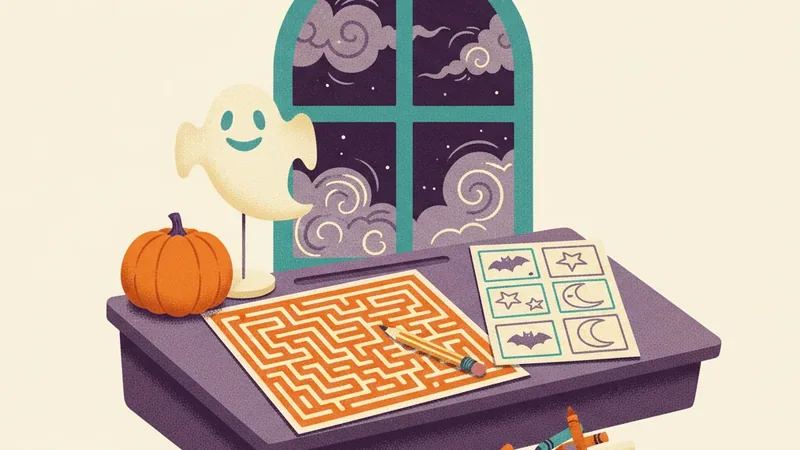
Twenty minutes at the end of a school day, 24 children, and a printer down the hall: that is when a Halloween activities worksheet earns its place. The sheet that works is the one that matches what each child can already do, so a 4-year-old gets a coloring page and a 9-year-old gets a crossword. The ladder below runs from crayon grip to crosswords, with how many sheets to print for your slot.
Start with what the child can do today
Grade is a rough guide. In October a first-grade room holds chapter-book readers next to children still sounding out "bat". Two quick checks pick a better sheet than the number on the door. The first is the pencil, and the CDC lists holding a crayon or pencil between fingers and thumb as a milestone by age 4. A child still working with a fist grip needs big shapes and thick crayons.
The second check is letters, and by age 5, the CDC says, a child writes some letters in her name and counts to 10. Before that stage, give sheets that need no reading, which means coloring, color by number and short mazes. Once letters and counting are in, word searches and picture sudoku open up. Watch the first two minutes with any new sheet. If the child asks what to do three times, the sheet is one level too high.
The skill ladder, from crayon to crossword
Every Halloween worksheet asks for one skill before any Halloween knowledge. Sorted by that skill, the eight common kinds sit on five steps.
- Coloring pages, from age 3, for fine motor. Big shapes first, finer detail as the grip settles.
- Color by number, ages 4 to 8, for number recognition. A key tells the child which crayon goes with which number.
- Mazes, from age 5, for planning and pencil control. Short and wide for kindergarten, long with dead ends from grade 2.
- Word searches, scrambles with picture clues, 4 x 4 picture sudoku, picture codes and odd-one-out rows, from age 6, for reading and logic.
- Crosswords, from age 8, for vocabulary and patience.
A child can sit on two steps at once, and a 6-year-old who reads well may still want a maze after a word search. What does not work is skipping a step upward, like handing a crossword to a child who has never finished a word search.
Coloring and color by number while the crayon grip is still new
For a 3- or 4-year-old, the line matters more than the picture. Thick outlines and regions the size of a thumb let a new grip stay inside the shape. Which line weight and crayon fit which age is covered in matching a pumpkin page to the child's hand.
Color by number comes next, usually around age 4, once the child can read a single digit. Each region carries a number and a key at the bottom says which crayon it takes. When every number has its color, the picture is done.
Halloween Color by Number is one printable option for this step. Its four easy pictures suit children from about age 4, and two detailed pages are labeled for ages 8 and up. Every page carries the same five-color key, so a cup with orange, black, purple, teal and cream crayons covers the set. Colored answer keys close the 9-page PDF, which costs $3.00.
Any free coloring page with thick lines does the first step just as well. A child who will not sit for a sheet at all is not behind. Picture-only games for 3- to 5-year-olds fill the same ten minutes standing up.
Mazes, word searches and picture sudoku once letters and counting come
Around age 5 a maze becomes the first sheet with a right answer. Let the child trace the route with a finger first, because a wrong pencil line through a maze cannot be colored over. Word searches start at about age 6 with a small grid of 7 words and a picture beside each word.
Two habits keep a word-search table calm. Cross each word off the list as it is found, and circle in pencil so a mistake can be fixed. Picture sudoku is the gentlest start to logic, since in a 4 x 4 grid each picture appears once per row, column and box. No arithmetic is needed, so a 6-year-old who can compare pictures can finish one without help.
Halloween Puzzle Pack covers this step and the next in one print. It is made for ages 6 to 12 and holds 9 puzzles in two levels. Two mazes, picture sudoku in 4 x 4 and 6 x 6, two crosswords, a secret picture code, a word scramble and an odd-one-out sheet fill its 13 pages, with answer keys at the end, for $4.00. For a single sudoku, draw a 4 x 4 grid and use four Halloween stickers as the symbols. A free maze generator covers one maze.
Scrambles, codes and crosswords for children who read on their own
A child who finishes the maze in four minutes is ready for sheets that ask for spelling. A word scramble gives 10 or 12 Halloween words with the letters mixed, and the child writes each real word on a line. A picture beside each scramble lets a younger reader check the guess. A secret picture code gives each letter a picture and hides a short message. Children often want to write a message back.
Crosswords come last, from about age 8, starting with a picture crossword, where each clue is a drawing, and moving to a 12-word crossword with written clues in grade 3. Let children work crosswords in pairs, because each crossing hands one child a letter the other did not expect.
For a mixed group, one word search in three levels beats a single hard sheet. Halloween Word Search has six puzzles in three levels. The two easy 8 x 8 grids hold 7 words with a picture beside each, the medium 12 x 12 grids hold 12 words, and the hard 15 x 15 grids hide 15 words in all 8 directions, including backwards. Answer keys for all six are in the 10-page PDF, for $3.00.
With no printer, write ten Halloween words on the board with their letters mixed, and the scramble is ready in two minutes.
How many Halloween activity worksheets to print for 20, 30 or 45 minutes
Print for the length of the slot. A room stays quiet when every child can finish at least one page and a fast finisher always has a next one. Plan on about these counts.
- 20 minutes at the end of a school day. One short sheet per child, a maze or a small word search, plus a coloring page as the overflow for the first finisher.
- 30 minutes on a rainy afternoon or in a sub period. Two or three sheets per child, an easy and a medium one of the same kind.
- 45 minutes for a party block or a whole period. Three or four sheets per child across two kinds, with one spare of the easiest kind per child.
Print one answer key for yourself whatever the slot. When a free sheet comes without a key, solve one spare copy before class and keep it. On the 31st itself the after-school hour is often the only calm one. The National Retail Federation's 2026 survey found that 74% of consumers plan to celebrate, and one sheet is enough that day.
When a free sheet, a paid pack or your own sheet wins
For one sheet on one afternoon, a free printable is good enough, and the cost is time, since free pages come in mixed styles, some lack an answer key and some are sized for the wrong paper.
A paid set at $3 or $4 earns its price when you want six or nine pages that match, with US Letter and A4 in the same download and answer keys at the back. The PDF comes by email after checkout and prints as often as you need. Your own sheet wins when the words must match this week's spelling list, because no pack knows your list.
A paid puzzle pack is the wrong buy in three cases. Children under about 5 need coloring, and stapling eight printed scenes into a coloring book gives them more than any puzzle would. A lesson that must match a curriculum needs reading-comprehension or math sheets, which these packs do not hold. A group that needs to run after a long morning needs a game, since no sheet fixes wiggles.
Turn a filler sheet into ten minutes of reading or counting
A sheet teaches when it has one job. For reading, use a word search or a scramble and ask the child to read each word aloud before crossing it off. For counting, use color by number and ask how many regions carry the number 3 before the crayon starts. For writing, use a scramble or a picture code and have the child write the answer word in full letters.
Fast finishers can stretch the same page. A second route through the maze, or one sentence that uses three words found in the grid, costs no extra printing. Then spend two minutes afterward on a single question, "which word was hardest?" The answer is the next sheet to print.
Sources
- Centers for Disease Control and Prevention, Important Milestones: Your Child By Four Years (2026). Last checked October 7, 2026.
- Centers for Disease Control and Prevention, Important Milestones: Your Child By Five Years (2026). Last checked October 7, 2026.
- National Retail Federation, Halloween Data and Trends (2026). Last checked October 7, 2026.
How we write and check these guides: our editorial note.